Salem Had Witch Trials. Boston Had a Molasses Flood.
Salem and Boston sit close enough to share a vacation and enough trouble to fill centuries of uncomfortable conversations. Salem became famous for accusations of witchcraft, courtroom panic, maritime fortunes, and an October celebration that now attracts crowds large enough to frighten the original Puritans. Boston added revolutionaries, old burial grounds, argumentative taverns, secret meetings, crooked streets, and a deadly wave of molasses.
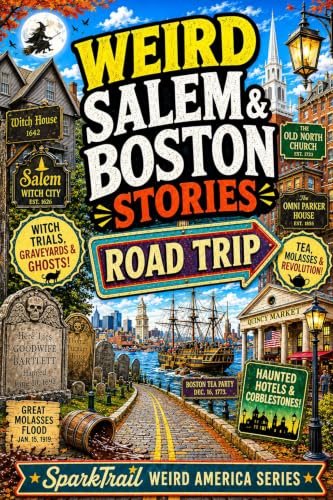
Weird Salem & Boston Stories, by SparkTrail Press and Guy Wann, connects the famous landmarks with the strange stories hiding behind them. It is a travel guide for readers who want the Freedom Trail and Salem’s historic center, but also want to know why spectral evidence entered a courtroom, why Boston once smelled like a bakery disaster, and why driving into Salem in late October is an excellent way to spend a day studying brake lights.
Salem’s Witch Trials Were a Legal Disaster, Not a Costume Party
The crisis began in 1692 when accusations spread through Salem Village, now Danvers, and neighboring communities. Fear, old grudges, religious tension, family disputes, and a court willing to accept deeply unreliable evidence turned suspicion into prosecution. Nineteen people were hanged. Giles Corey was pressed to death after refusing to enter a plea, and others died in jail.
One of the most damaging ideas was spectral evidence. Accusers claimed that a person’s spirit or apparition had harmed them, even when the accused was physically somewhere else. The court treated those claims seriously, creating a system in which defending yourself against an invisible version of yourself was understandably difficult. When later proceedings rejected spectral evidence, most remaining defendants were acquitted or pardoned. It was a little late for everyone already dead.
Modern Salem treats the tragedy in several ways. The Salem Witch Trials Memorial offers a quiet place to remember the victims. The Witch House preserves the home of Judge Jonathan Corwin. Nearby museums interpret the trials with varying mixtures of scholarship, theater, and gift shops. Visitors should distinguish the historic record from entertainment, because Salem contains plenty of both and sometimes places them on the same block.
Salem Was Also a Maritime Powerhouse
The witch trials dominate the city’s reputation, but Salem’s history did not stop in 1692. Its waterfront became part of a global trading network, sending ships to distant ports and returning with goods, wealth, and complicated consequences. Salem Maritime National Historical Park preserves wharves, warehouses, historic homes, and the old Custom House.
This side of Salem is especially useful when the downtown crowds become intense. Walk toward Derby Wharf, explore the waterfront, and remember that Salem once looked outward across the world rather than inward toward courtroom accusations. The outdoor park grounds remain accessible, while historic buildings and tours follow seasonal schedules. It is wise to check hours before arriving, because old houses maintain stricter calendars than ghosts.
Boston Put Revolution on a Red Brick Line
Boston’s Freedom Trail runs about two and a half miles through downtown, the North End, and Charlestown. The red brick or painted line connects churches, meeting houses, burial grounds, government buildings, revolutionary sites, and historic ships. It also prevents visitors from pretending they meant to wander into that souvenir shop for forty minutes.
The trail is free to walk, although individual attractions may charge admission. Trying to enter every site in one afternoon turns history into competitive speed walking, so choose priorities. The Old State House, Old North Church, Granary Burying Ground, USS Constitution, and Bunker Hill can easily consume more time than expected. Comfortable shoes matter. Boston’s streets were designed long before anybody suggested that a city map should behave logically.
The Graveyards Are Full of Famous Names and Peculiar Art
Boston’s old burial grounds contain governors, ministers, revolutionaries, merchants, soldiers, and ordinary residents whose neighbors eventually became street names. Granary Burying Ground is associated with figures including Samuel Adams, John Hancock, and Paul Revere. Copp’s Hill overlooks the harbor from the North End and preserves generations of local history.
The stones themselves deserve attention. Winged skulls, hourglasses, bones, cherubs, and other symbols show changing ideas about death and remembrance. These are historical sites, not outdoor movie sets. Stay on open paths, avoid touching fragile markers, and save dramatic cape poses for somewhere without three hundred years of worn sandstone.
Then Boston Was Hit by Molasses
On January 15, 1919, a huge storage tank in the North End ruptured and released about 2.3 million gallons of industrial molasses. The wave moved through the neighborhood with astonishing force, damaging buildings, shifting structures, knocking equipment from its path, and trapping people and animals in wreckage that became harder to move because everything was coated in syrup.
Twenty one people died and around 150 were injured. The disaster was not a charming incident about a city becoming temporarily sticky. Residents had already reported that the tank leaked, and later investigation exposed serious structural failures. The owners initially suggested sabotage, but a lengthy legal case placed responsibility on negligence. A small marker near Langone Park remembers the disaster today. It is easy to miss, which is very Boston. The city will give an enormous event one modest plaque and assume you brought context.
How to Visit Without Joining the Traffic Disaster
Boston works well as a base, with Salem reached by commuter rail or seasonal ferry. In October 2026, Salem expects heavy traffic, parking restrictions, and road closures, especially on weekends and Halloween. The city is not providing its former weekend parking shuttle this year, and officials strongly encourage visitors to arrive by train or ferry. Reservations for attractions and tours are strongly recommended.
For a calmer visit, choose a weekday, arrive early, and give Salem a day. Give Boston another full day for a selective Freedom Trail route and the North End. Trying to combine both cities in one hurried afternoon produces excellent photographs of train platforms and very little history.
Take the Strange Route Through New England
Weird Salem & Boston Stories brings together witch trial history, haunted legends, revolutionary arguments, graveyards, taverns, maritime fortunes, the molasses flood, and practical planning for two cities that have never been short of drama. It is for travelers, history readers, and anyone who suspects New England became respectable only after hiding the strangest stories behind brick buildings.
Explore more unusual road trips on the SparkTrail Weird America series page, or browse the complete SparkTrail Press book catalog.