Rome Let the Statues Talk and the Cats Take Over
SparkTrail Weird Europe Travel
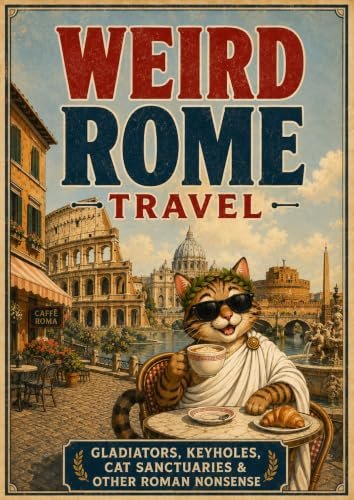
Ancient gladiators, secret keyholes, talking statues, cat sanctuaries, Vatican oddities, and other Roman nonsense.
Rome has spent nearly three thousand years accumulating emperors, saints, assassins, artists, bones, fountains, cats, traffic, and opinions. It has not sorted any of them. They are all still here, sometimes occupying the same street corner.
The city stacks a church on a temple, parks a scooter beside an ancient column, and lets cats supervise the place where Julius Caesar was stabbed. WEIRD ROME TRAVEL is built for travelers who want the Colosseum and the Vatican, but also want to know why statues once traded insults and why a tiny keyhole has become one of the city’s strangest views.
The Colosseum Was Never Subtle
The Colosseum is the obvious place to begin because ancient Rome believed entertainment should involve eighty entrances, enormous crowds, trapdoors, wild animals, professional fighters, and the possibility that the audience might demand a different ending. Modern stadiums have nachos. Rome had elevators for lions.
The useful part is less theatrical. Colosseum tickets use timed entry, popular slots disappear quickly, and standard sales generally open thirty days ahead. Buy from the official Colosseum ticket site, make sure the ticket name matches the visitor carrying it, and bring identification. Arrive with time for security, but not so early that you spend an hour circling the building like a confused legion.
Wear comfortable shoes. Ancient stones are beautiful, uneven, and entirely uninterested in fashionable footwear. A morning visit is kinder in warm weather, and combining the Colosseum with the Forum and Palatine Hill makes historical sense even if your feet file a formal objection.
Rome Keeps Entire Cities Under Its Streets
Walk through the Forum and the city’s layers become impossible to ignore. Temples became quarries. Political platforms became picturesque ruins. Triumphal arches survived emperors who were certain their names would last forever. Rome is a reminder that marble is durable and reputations are not.
Look down when entering an old church or passing a construction site. Ancient paving, buried houses, forgotten shrines, and pieces of imperial infrastructure appear across the center. This is fair warning that Rome has more downstairs than most cities.
The Statues Have Complaints
Near Piazza Navona stands Pasquino, a battered ancient statue with a successful second career in political commentary. Beginning in the sixteenth century, Romans attached anonymous satirical verses to it. Other statues joined the imaginary conversation, creating a network of “talking statues” that mocked popes, rulers, and anyone behaving as though authority made them immune to jokes.
Pasquino is not Rome’s prettiest sculpture. That is part of the charm. He looks exactly like someone who has heard five centuries of gossip and remains unimpressed. Finding the talking statues turns a walk through the historic center into a scavenger hunt with better insults.
Caesar, Cats, and Largo di Torre Argentina
Largo di Torre Argentina contains Republican-era temples and part of the complex associated with Julius Caesar’s assassination. Naturally, it is also famous for cats. Rome’s volunteer-supported felines lounge among the ruins with the confidence of creatures who know the empire now belongs to them.
The ruins can be viewed from street level, and access arrangements may change, so check locally before planning around entry. It is an easy stop between the Pantheon, Campo de’ Fiori, and the Jewish Ghetto. Respect the sanctuary, do not feed animals without guidance, and accept that every photograph improves if a cat walks into it.
A Keyhole With a Very Good Publicist
On the Aventine Hill, the keyhole at the Priory of the Knights of Malta frames St. Peter’s dome at the end of a garden avenue. One eye sees three sovereign territories aligned through a hole in a door, plus a perfectly centered dome that appears suspiciously cooperative.
There may be a queue, especially near sunset. Keep the viewing moment brief, let the next person have a turn, and do not block the gate while conducting a photography seminar. The nearby Orange Garden offers broad views without requiring anyone to press an eyebrow against metal.
When Bones Become Baroque
The Capuchin Crypt beneath Santa Maria della Concezione contains chapels decorated with the bones of thousands of friars. Skulls form arches. Vertebrae become patterns. The effect is not a haunted-house stunt, even if your nervous system initially disagrees. It is a meditation on mortality expressed through an artistic vocabulary that never learned the phrase “too much.”
Dress and behave as you would in a religious site, and follow posted photography rules. The crypt is compact and close to Piazza Barberini, making it easy to pair with the Trevi Fountain before the largest crowds arrive. Tossing a coin after contemplating several thousand bones feels like a very Roman approach to long-term planning.
The Vatican Requires Strategy
The Vatican Museums are spectacular, enormous, and capable of making a confident traveler forget which century they are in. Reserve through the official Vatican Museums site because lookalike sellers and inflated “skip the line” offers flourish online. There is no magical hour when the Sistine Chapel becomes your private living room, but early and late entries can feel less frantic.
Wear clothing suitable for religious spaces, carry water where permitted, and do not try to “quickly see everything.” Choose a few priorities, allow time for the route to twist, and remember that the gift shop will find you whether you are ready or not.
How to Survive Rome’s Beautiful Nonsense
Rome rewards walkers, but it also rewards people who know when to stop walking. Group sights by neighborhood, use transit for longer jumps, and leave room for delays. Cobblestones, stairs, heat, crowds, and an irresistible gelato detour can turn a tidy itinerary into speculative fiction by lunchtime.
Carry a refillable bottle for the public drinking fountains, keep valuables secured in dense tourist areas and on transit, and cross busy streets with attention rather than optimism. Book the Colosseum and Vatican first. Everything else can orbit those fixed times.
Most importantly, do not treat the strange details as distractions from “real Rome.” They are real Rome. The talking statues, underground chambers, bone chapels, sacred cats, imperial scandals, and perfectly framed keyhole reveal how the city has survived: by reusing everything, forgetting nothing, and refusing to become sensible.
Take the Weird Route Through Rome
WEIRD ROME TRAVEL by SparkTrail Press and Guy Wann leads curious travelers past the postcard landmarks and into the stories that make them worth seeing. Explore more peculiar destinations in the SparkTrail Weird Europe Travel series, or browse the complete SparkTrail Press book catalog.
Choose your Roman adventure