Amusement Parks Charged a Nickel to Scare You and Never Stopped
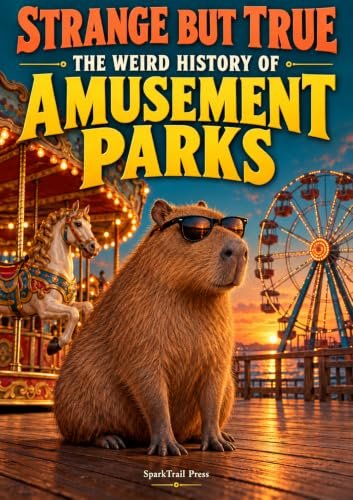
Amusement parks make a peculiar promise: hand over money, stand in line, surrender control to a machine, and enjoy being frightened in public. This business model sounds questionable until the music starts, the lights come on, and someone nearby purchases a snack large enough to qualify as furniture.
Strange But True: The Weird History of Amusement Parks follows the long road from pleasure gardens and mechanical horses to roller coasters, moon trips, funhouses, midway tricks, failed dream parks, and the modern industry of organized screaming. The rides changed, but the sales pitch remained wonderfully direct. Step right up. Something improbable is about to happen.
Pleasure gardens invented the expensive night out
Before amusement parks had turnstiles and roller coasters, European pleasure gardens mixed landscaped walks, food, music, dancing, fireworks, theatrical spectacles, and the useful possibility of being seen in fashionable clothing. London’s Vauxhall Gardens began in the seventeenth century and became one of the most famous. Visitors came for orchestras and elegant promenades, then stayed for balloon ascents, acrobats, drinking, gossip, and whatever happened in the darker paths.
The gardens established a pattern that parks still use. Sell admission, create an atmosphere, provide several kinds of entertainment, and make leaving feel like a failure of imagination. When competition increased, the attractions grew louder and more extravagant. Fireworks, animals, balloons, and elaborate performances were early versions of the modern park’s constant demand for something new.
Carousels began as practice for people with weapons
The carousel’s distant ancestors were training devices used in mounted games. Riders practiced horsemanship by circling and attacking targets. Over time, the horses became carved figures, the combat disappeared, and the whole apparatus became family entertainment. This was a considerable improvement for anyone who wanted music without being struck by a lance.
Early merry-go-rounds could be powered by people, animals, or cranks. Steam power helped create the larger machines recognized today. Immigrant woodcarvers turned carousel animals into moving folk art, adding dramatic manes, glass eyes, decorated saddles, and expressions suggesting that the horse knew the ride would never reach an actual destination.
The first roller coasters were surprisingly polite
Roller coaster history grew from gravity railways and scenic rides. In 1884, La Marcus Thompson opened the Switchback Railway at Coney Island. It traveled at about six miles per hour, charged a nickel, and required passengers to leave the car at the end so it could be turned around for the return journey. It was less a terrifying plunge than an unusually complicated method of moving several hundred feet.
That gentleness did not last. Designers added circuits, tunnels, steeper drops, restraints, and increasingly ambitious structures. The Flip Flap Railway sent riders through a circular loop in the 1890s, proving that engineers could make a ride memorable before fully understanding how the human neck preferred to spend the afternoon. Each new attraction encouraged competitors to build something faster, taller, stranger, or more difficult to explain to an insurance company.
The Ferris wheel was America’s answer to the Eiffel Tower
The 1893 World’s Columbian Exposition in Chicago needed a spectacular attraction to rival the Eiffel Tower. Engineer George Washington Gale Ferris Jr. responded with a rotating steel wheel 264 feet high. Its 36 cars could hold up to 60 passengers each. This was not a quiet carnival wheel for two people and an anxious operator. It was a moving building with excellent views and a name that became generic.
The wheel demonstrated a recurring amusement park principle. If a machine is enormous, visually impossible, and slightly worrying, people will buy tickets. Its success turned the Ferris wheel into a fairground standard and made romantic views available to anyone comfortable being romantic inside a steel circle suspended above Chicago.
Coney Island sold trips to the moon
At the beginning of the twentieth century, Coney Island became a laboratory for mass entertainment. Steeplechase Park offered mechanical horse racing. Luna Park glittered under an astonishing forest of electric lights. Dreamland added monumental architecture and attractions with names that treated subtlety as an enemy.
One celebrated attraction promised a Trip to the Moon. Riders boarded a fantasy airship, watched theatrical effects create the illusion of flight, and arrived in a lunar world populated by performers. No rocket was required. The experience depended on scenery, machinery, lighting, actors, and the audience’s willingness to participate in a magnificent lie.
Other attractions simulated voyages, disasters, foreign cities, polar expeditions, fires, floods, and battles. A visitor could travel around the world, witness destruction, ride a horse, and eat something fried without leaving the boardwalk. Early parks understood immersive entertainment long before anyone used the word immersive every six minutes.
Funhouses turned embarrassment into a feature
Funhouses offered moving floors, spinning barrels, crooked rooms, air jets, mirrors, slides, and devices designed to make dignified adults lose an argument with gravity. The entertainment came partly from experiencing the obstacle and partly from watching the next person discover it.
Midway games worked on a similar blend of hope, skill, presentation, and selective mathematics. Bright prizes made victory look one easy toss away. Some games were fair tests, some were brutally difficult, and some had reputations that inspired the phrase “step right up” to sound like a legal warning. The strange business of having fun has always included the strange business of persuading people they are about to beat the system.
Failed parks leave the best ghost stories
Amusement parks are expensive machines built on changing tastes. Fire, weather, financial trouble, new transportation patterns, land values, and competition have ended many ambitious parks. Wooden attractions were especially vulnerable, and Coney Island’s history includes devastating fires that erased entire fantasy landscapes.
Abandoned parks fascinate people because the structures were created for noise, color, crowds, and laughter. Empty tracks and silent ticket booths feel wrong. A closed factory still looks like a factory. A deserted amusement park looks like the fun left suddenly and forgot to turn off the creepy music.
The history behind the scream
The Weird History of Amusement Parks explores pleasure gardens, mechanical horses, moon voyages, wild rides, midway schemes, giant engineering experiments, failed dreams, and the people who learned how to sell excitement by the ticket. It is for readers who enjoy strange history, nostalgic attractions, and the machinery behind a day of fun.
Find more wonderfully odd history in the SparkTrail Strange But True series, or explore the complete SparkTrail Press catalog. The next time a ride operator lowers the safety bar, remember that generations of inventors worked very hard to make your scream commercially reliable.