California Found Gold. Everybody Else Lost Their Minds.
One bright speck in a California millrace was enough to break the nineteenth century’s attention span. On January 24, 1848, James Marshall spotted gold while helping build a sawmill near the American River. Marshall and John Sutter tried to keep the discovery quiet, which worked about as well as hiding free money behind a curtain. News escaped, President James K. Polk confirmed it, and thousands of people decided that farms, jobs, families, and basic caution were suddenly optional.
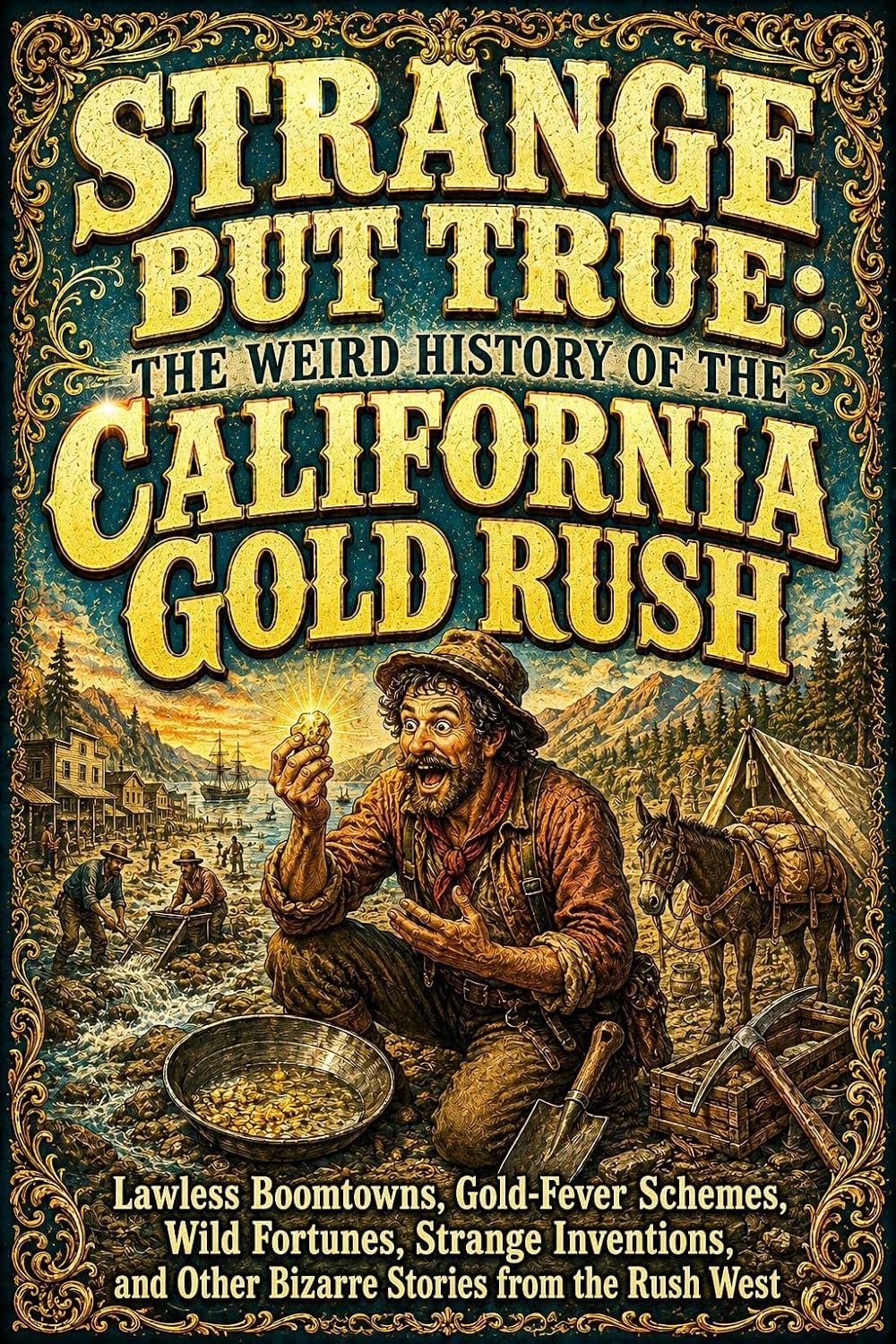
STRANGE BUT TRUE: THE WEIRD HISTORY OF THE CALIFORNIA GOLD RUSH, by SparkTrail Press and Guy Wann, follows the rush beyond the familiar picture of a bearded miner kneeling beside a stream. The real story includes abandoned ships, homemade courts, salted claims, outrageous prices, ingenious machines, international communities, devastating prejudice, and people who crossed half the planet only to discover that the shovel seller had the better business plan.
A Discovery That Refused to Stay Secret
Marshall found the metal at Sutter’s sawmill on the South Fork of the American River. More gold appeared nearby, and the two men understood immediately that publicity might ruin Sutter’s agricultural ambitions. Their problem was that employees had eyes, travelers had mouths, and merchants recognized a sales opportunity from several valleys away. By the time official confirmation reached the wider country, gold fever was no longer an announcement. It was a diagnosis.
Three Ways West, All of Them Uncomfortable
Hopeful miners came overland, sailed around Cape Horn, or took ships to Central America and crossed the isthmus before finding another vessel north. Every option demanded money, patience, and a flexible definition of personal comfort. The overland trail offered dust, disease, dangerous river crossings, exhausted animals, and the growing suspicion that the mapmaker had never visited the map. Sea routes traded wagon trouble for storms, delays, cramped quarters, and months of close acquaintance with strangers.
San Francisco Misplaces Its Sailors
Gold fever changed San Francisco with astonishing speed. Crews deserted ships in the bay and headed inland, leaving vessels without enough hands to sail. Some ships were repurposed as warehouses, hotels, saloons, stores, and other buildings. As the shoreline expanded, remains of old vessels were buried beneath the growing city. San Francisco did not merely develop around the rush. It began absorbing maritime history into the ground like an unusually ambitious scrapbook.
The boom also created instant demand for beds, meals, clothing, tools, transportation, entertainment, and nearly everything else a city needs. Prices could become outrageous because supply moved slowly while customers arrived quickly. A person might dream of scooping wealth from a river and instead spend a painful amount on eggs. California had found gold, but breakfast had discovered pricing power.
The Safest Gold Mine Often Had a Counter
Some of the most dependable fortunes came from serving miners. Merchants sold picks, pans, boots, food, lumber, laundry, and replacement supplies to people whose equipment wore out almost as quickly as their optimism. A prospector’s income depended on luck, geology, competition, weather, and whether somebody had already worked the promising ground. A shopkeeper simply needed customers, and the Gold Rush supplied them by the wagonload.
Claims, Courts, and Creative Cheating
Mining camps developed rules because official government often arrived after the crowd. Miners organized districts, marked claims, settled disputes, and created local procedures with varying amounts of fairness and sobriety. These systems could keep order, but they could also exclude newcomers, favor powerful groups, and turn arguments into violence. The frontier was not lawless so much as crowded with people urgently inventing law while standing on valuable dirt.
Where hope went, scams followed. Unscrupulous sellers could “salt” a worthless claim by planting gold where a buyer would test it. Dubious maps, exaggerated reports, miracle equipment, and investment schemes multiplied around the honest discoveries. The Gold Rush became an early master class in a permanent human weakness: if someone wants wealth badly enough, another person will offer a shortcut with excellent confidence and terrible paperwork.
A Global Rush With a Heavy Cost
The goldfields drew people from across the United States, Mexico, Latin America, Europe, China, Australia, and beyond. Camps were international places filled with languages, foods, skills, rivalries, and new businesses. Women, Black pioneers, Californios, immigrants, and entrepreneurs shaped the region in ways that the standard lone-prospector story often misses. California became more connected to the world while its communities were being improvised at alarming speed.
The rush also brought violence, discriminatory taxes, displacement, disease, and enormous suffering, especially for Native Californians. Foreign miners faced hostility and laws designed to push them from claims. A funny history can laugh at ridiculous prices, failed gadgets, and spectacular greed without treating the human damage as a punchline. The truth is more interesting when the full cast is allowed into the story.
When the Mountains Became the Equipment
Easy placer deposits did not last forever. Miners adopted rockers, sluices, shafts, hard-rock operations, and eventually hydraulic mining. High-pressure water blasted hillsides apart to reach ancient gravel deposits. It was technically impressive and environmentally catastrophic. Debris choked rivers, raised beds, polluted water, and increased flooding risks downstream. The search for small pieces of metal grew powerful enough to rearrange entire landscapes.
Turn the History Into a Gold Country Trip
The story becomes especially vivid in California Gold Country. Coloma and Marshall Gold Discovery State Historic Park connect visitors to the original discovery site. Columbia State Historic Park preserves the shape and atmosphere of a Gold Rush town, while museums and historic districts across the Sierra foothills reveal how mining, commerce, migration, and daily life fit together. These places are easier to appreciate when you know why a sawmill mattered, why stores sometimes beat mines, and why the landscape itself became evidence.
Meet the Rush That Was Stranger Than the Legend
The Weird History of the California Gold Rush follows sudden fortunes, crushing failures, camp traditions, strange inventions, international miners, environmental upheaval, and true events that sound suspiciously invented. It is funny without ignoring the serious history and detailed without behaving like a textbook that has confiscated everyone’s personality.
The gold was real. Almost everything people did after finding it was where the story became wonderfully, disastrously strange.
Start digging into the strange history
Read the Kindle edition or listen to the audiobook.
Keep exploring: Visit the SparkTrail Strange But True series or browse all SparkTrail Press books.