Route 66 Turns 100 and Still Refuses to Behave
Route 66 reaches its 100th anniversary in 2026, proof that a highway can survive fame, abandonment, reinvention, and millions of souvenir magnets. Created in 1926, the Mother Road linked Chicago with Los Angeles across roughly 2,400 miles. It became a migration route, a vacation dream, a business opportunity, and eventually the most famous road in America that no longer officially exists.
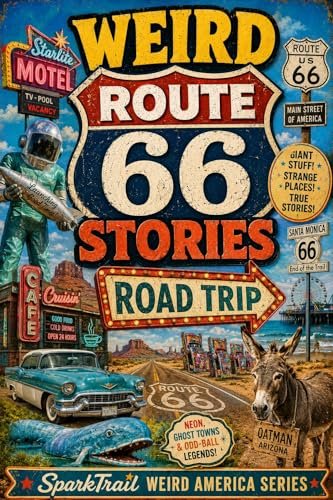
Weird Route 66 Stories: A Funny Travel Guide to the Mother Road’s Strangest Stops, Roadside Legends, Neon Diners, Ghost Towns & Desert Oddities follows the history and peculiar personality of that journey. This is not a book that treats the highway like a straight line between two cities. Route 66 was never very interested in straight lines, and its best stories usually begin where the efficient road turns away.
The Highway That Became a Celebrity
Route 66 had practical work to do. It connected farms, towns, mining areas, cities, and western markets while automobile travel was reshaping the country. During the Dust Bowl years, families used it while searching for work and stability in California. After World War II, growing car ownership turned the road into a vacation corridor filled with families chasing scenery, sunshine, motels, and the deeply American belief that lunch tastes better beneath a flashing neon sign.
Decommissioned, Not Defeated
Modern interstates gradually bypassed Route 66, and the highway was officially removed from the federal system in 1985. That could have ended the story. Instead, towns, preservation groups, business owners, historians, and stubborn road trippers began saving signs, buildings, bridges, alignments, motels, and memories. More than 250 Route 66 places are now listed on the National Register of Historic Places, and the road remains one of the world’s most recognizable travel routes.
The important practical detail is that historic Route 66 is not one perfectly continuous modern highway. It has changed alignments, broken sections, frontage roads, city streets, and stretches that require returning to the interstate. A successful trip needs a current map or navigation guide specifically made for historic Route 66. Following an old shield painted on the pavement with absolute confidence is romantic right up until it deposits you beside a locked gate.
Neon Was a Survival Strategy
Classic Route 66 businesses had to catch the attention of motorists moving past at speed. Subtlety was not useful. Motels became brighter, cafés grew larger signs, filling stations adopted memorable shapes, and roadside attractions discovered that a giant animal could make a tired family hit the brakes. The result was a commercial art form built from neon, paint, sheet metal, optimism, and the assumption that every building would improve if it could be seen from another county.
Giant Things, Wigwam Motels, and Other Sensible Ideas
The Mother Road is populated by oversized muffler men, enormous animals, leaning water towers, decorated cars, concrete whales, and buildings shaped like things buildings do not normally resemble. The Wigwam Motels in Holbrook, Arizona, and San Bernardino, California, preserve a style of roadside lodging that became part of the highway’s visual mythology. Near Amarillo, Cadillac Ranch turns buried automobiles into an ever-changing public canvas covered in paint.
These stops can look silly, but silliness is part of the history. Small businesses needed a reason for motorists to choose their fuel, food, beds, and gifts instead of continuing ten miles down the road. A giant blue whale or enormous fiberglass cowboy was not random decoration. It was marketing with eyebrows, and it worked so well that travelers still cross the country to photograph it.
Ghost Towns and the Cost of a Faster Road
When interstates pulled traffic away, some Route 66 communities lost their economic lifeline almost overnight. Motels emptied, gas stations closed, and once-busy main streets grew quiet. The ruins are fascinating, but they are also reminders that the romance of the open road depended on real families and businesses.
Travelers can help preserve what remains by spending money at independent diners, museums, motels, shops, and restored attractions. Buy the pie, pay the admission, and resist treating every old property as an abandoned movie set available for trespassing. The Mother Road survives because people care for it, not because the desert politely agreed to stop weathering things.
Eight States, Eight Different Personalities
Illinois opens with city streets and prairie towns. Missouri adds Ozark curves and roadside caverns. Kansas contributes only a short stretch, but it refuses to be ignored. Oklahoma offers some of the road’s deepest history, museums, and surviving mileage. Texas delivers open horizons and roadside spectacle, while New Mexico brings trading posts, old alignments, and layers of Southwestern culture.
Arizona supplies high desert, small towns, classic motels, and long preserved sections. California carries the route through the Mojave Desert toward Los Angeles and the Pacific. Trying to race through all eight states turns a legendary road trip into an endurance test with gift shops. The road rewards travelers who stop often enough to discover why each region looks, tastes, and tells stories differently.
How to Drive It Without Ruining It
A complete Route 66 journey deserves at least two weeks, and more time is better. Travelers with fewer days should choose one region instead of treating the mileage like a punishment. Check attraction hours because small museums and family businesses may close early or operate seasonally. Reserve distinctive motels ahead during major centennial events, carry water in desert sections, keep the fuel tank comfortably filled, and expect road conditions to vary.
Build slack into the schedule. The most memorable stop may be a restored station, a local museum, a diner recommendation, or a faded sign that was not on the original plan. Route 66 is at its best when curiosity is allowed to delay lunch. If every minute is scheduled, the traveler may technically see the road while completely missing its personality.
Take the Weird Route
Weird Route 66 Stories, by SparkTrail Press, mixes road history, roadside legends, ghost towns, neon landmarks, desert oddities, practical travel help, and enough strange stops to keep the Mother Road from becoming a long lecture about pavement. It works as a trip-planning companion, an armchair journey, or a reminder that America’s most famous highway became immortal by refusing to be ordinary.
Get your kicks and the strange stories
Read the book or take the audiobook along for the drive.
Keep exploring: Visit the SparkTrail Weird America series or browse all SparkTrail Press books.