Washington Put Bigfoot in the Rain and a Troll Under a Bridge
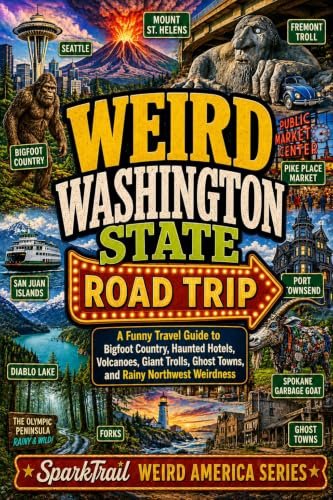
Washington has mountains that explode, forests that allegedly hide eight-foot celebrities, buried streets, and a concrete troll gripping a Volkswagen beneath a bridge. The state also has enough rain to keep every legend moisturized.
Weird Washington State Road Trip explores the odd corners between Seattle, the Pacific coast, Mount St. Helens, the Olympic Peninsula, and the dry country east of the Cascades. It is a road trip for travelers who like scenery, history, roadside curiosities, and the occasional attraction that raises more questions than it answers.
Seattle put a troll under a bridge
Begin in Fremont, where an 18-foot concrete troll crouches beneath the Aurora Bridge with a real Volkswagen Beetle in one hand. The sculpture arrived in 1990 after a public art competition transformed an awkward space beneath the bridge into one of Seattle’s most photographed landmarks. It is free, wonderfully strange, and far more cooperative than most bridge trolls in traditional stories.
Troll’s Knoll Park sits beside it with paths and seating. Visit early for easier photographs, expect tight street parking, and wear shoes suited to steep streets and fast-changing weather.
The city underneath the city
Seattle’s Pioneer Square has another city hiding below sidewalk level. After the Great Seattle Fire of 1889, the rebuilt streets rose above parts of the old commercial district. Today, guided underground tours lead through buried storefronts and passageways where nineteenth-century Seattle sits beneath modern traffic, looking as if everyone left for lunch and forgot to return.
Book a timed tour rather than relying on optimism. Expect uneven floors, stairs, and enclosed areas. Nearby, Pike Place Market offers food, flying fish, and the Gum Wall. It is public art if one is generous and a dental emergency if one looks too closely.
Bigfoot country comes with volcanic scenery
Southwest Washington has long been Bigfoot country. In 1924, miners claimed that large, hairy creatures attacked their cabin with rocks near Mount St. Helens. Legend has it that the creatures kept them trapped through the night. Newspapers loved the Ape Canyon story, which may be the least surprising part.
Ape Canyon is a real place, and Ape Cave is a real lava tube, although the cave was named for the scout group that explored it rather than for a resident monster. Ape Cave uses seasonal access and reservations, and winter conditions can close roads or make the area unsuitable for casual exploration. Check the Forest Service before setting out. Bigfoot may ignore schedules, but travelers should not.
Mount St. Helens rearranged the map
Mount St. Helens proves that Washington’s mountains are active geology rather than decorative wallpaper. The 1980 eruption removed the summit, flattened forests, and changed surrounding valleys. Visitor centers and overlooks explain the event while the landscape shows how forests recover.
Roads, viewpoints, and visitor services are seasonal, especially after autumn weather arrives. November travelers should check current conditions before leaving the interstate, keep fuel in the tank, and carry food, water, warm layers, and an offline map. A mountain road is a poor place to discover that the phone has entered its own private wilderness retreat.
The coast has an alligator man
Long Beach offers ocean views, wind, kites, saltwater taffy, and Jake the Alligator Man. Jake lives at Marsh’s Free Museum, a family-owned collection of curiosities, old machines, taxidermy, souvenirs, and objects that seem to have escaped from several different centuries. Jake appears to be half human and half alligator, although his biography becomes much less reliable when anyone asks follow-up questions.
The museum is an easy coastal stop when the weather performs its sideways-rain routine. Walk the boardwalk when the sky behaves, then retreat indoors when the Pacific throws water at the windows.
Washington built its own Stonehenge
Above the Columbia River near Maryhill stands a full-scale concrete Stonehenge. It was built by Sam Hill between 1918 and 1929 as a memorial to Klickitat County soldiers who died in World War I. The monument is free to visit and open from morning until dusk. It is both an unusual roadside sight and a serious memorial, so photographs are welcome while climbing on the structure is not.
The setting offers broad Columbia Gorge views. This region is much drier than Seattle, although wind can be fierce and winter roads icy. A jacket remains useful even when the sun is acting confident.
The Olympic Peninsula lets nature get theatrical
The Olympic Peninsula adds moss-heavy rain forests, stormy beaches, giant driftwood, sea stacks, and trees that appear to be negotiating with gravity. The famous Tree of Life near Kalaloch stretches roots over an eroded opening, looking impossible and increasingly fragile. Admire it from a safe distance. Coastal erosion, falling branches, sneaker waves, and unstable bluffs are real hazards, even when the scenery looks ready for a fantasy film.
Park roads and high routes can close for ice, storms, or washouts, so check conditions that day. Allow extra time because peninsula distances are long and a “quick scenic stop” can become forty minutes of staring at a beach while forgetting dinner.
How to make the weird road trip work
Washington is best explored in sections rather than as one heroic dash. Seattle and Puget Sound can fill several days. Mount St. Helens and the Columbia Gorge deserve their own loop. The Olympic Peninsula is large enough to punish rushed itineraries. Ferries add scenery but also schedules, so check departure times and arrive early.
Pack waterproof layers, comfortable shoes, a car charger, and patience. Mountain and coastal weather can differ completely. Reserve popular tours, then leave space for small museums, roadside statues, and unplanned cafés. Those detours are where Washington stops behaving normally.
A guide for the beautifully strange Northwest
Weird Washington State Road Trip brings together Bigfoot stories, haunted hotels, volcanoes, giant trolls, ghost towns, buried streets, coastal curiosities, and practical help for planning the journey. It is for travelers who want the famous scenery and the odd stories hiding behind it.
Explore more unusual American destinations in the SparkTrail Weird America series, or browse the full SparkTrail Press catalog. Washington will provide the mountains, rain, trolls, and suspicious footprints. You only need to bring a route and a jacket.