Firearms History Invented Pocket Cannons, Duck Feet, and Several Terrible Ideas
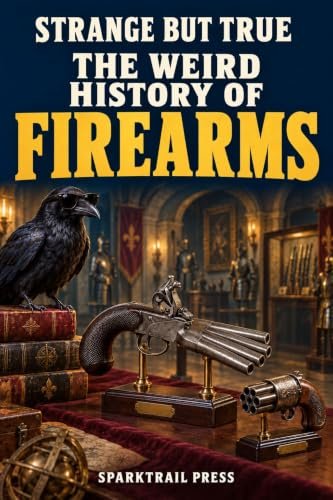
Firearms history did not march neatly from one sensible invention to the next. It lurched through pocket cannons, fan shaped pistols, rotating barrel clusters, alarming recoil, and ideas that looked much better on a patent drawing.
Before the sleek museum cases and confident labels, early firearms were slow, smoky, temperamental, and occasionally more threatening to the person holding them than to anyone standing at a polite distance. Inventors responded by adding barrels, stranger mechanisms, smaller packages, larger packages, and the mechanical equivalent of shouting, “This should probably work.”
Strange But True: The Weird History of Firearms tours the wrong turns, clever solutions, improbable survivors, and inventions that shaped history even when history politely declined to adopt them.
When a Cannon Became Hand Luggage
The earliest hand cannons were exactly as subtle as the name suggests. Take the idea of artillery, shrink it, attach it to a handle, and ask someone brave to point the smoky end away from everyone they liked. Crude as they were, these weapons changed battlefields because armor, walls, and old assumptions suddenly had a loud new problem.
Designers then spent centuries making firearms easier to carry, faster to fire, and less dependent on favorable weather. Matchlocks brought a burning cord to the job. Wheellocks used intricate spark making machinery. Flintlocks simplified matters, at least by the standards of devices still involving loose powder, smoke, and dramatic disappointment.
The Duck’s Foot Solution to Too Many Directions
The duck’s foot pistol is one of those objects named by the first person who saw it. Several barrels spread outward like webbed toes, allowing one discharge to cover a wider area. It was the firearm equivalent of waving both arms and hoping the general message reached the room.
Versions appeared from the eighteenth century into the early nineteenth century, before repeating handguns were practical. Multiple barrels offered immediate firepower but also added weight, awkward handling, and abundant smoke. The design made visual sense in crowded, close quarters, which helps explain its association with shipboard defense. It also looks like something a cartoon pirate would reject as excessive.
Seven Barrels, One Trigger, Two Regretful Shoulders
The Nock volley gun carried the same enthusiasm into a larger package. Designed in 1779 and manufactured by Henry Nock, it grouped seven barrels for naval use. Sailors could fire a burst from high in a ship’s rigging toward an enemy crew or its equipment. Seven barrels meant formidable recoil, and sparks near ropes, sails, and tarred wood were not an ideal contribution to maritime safety.
The gun remains fascinating because it addressed a real tactical problem with the available technology. It simply proved that solving one problem can introduce several new ones, including the discovery that the human shoulder is not a naval gun carriage.
Pepperboxes and the Revolving Bouquet of Trouble
By the nineteenth century, pepperbox pistols offered multiple shots from a rotating cluster of full length barrels. The name came from their resemblance to pepper grinders, proof that alarming machinery can benefit from friendly kitchen branding. Some carried six or seven barrels, and pulling the trigger could cock the mechanism and rotate the cluster.
Pepperboxes became popular in America and Europe before the familiar revolver took over. They offered compact repeat fire without a separate fixed barrel and cylinder. They also created a front heavy little machine with enough tubes to make every coat pocket look suspiciously ambitious. In museum cases, their mechanisms, engraving, folding triggers, and crowded barrels reward a close look.
Patent Drawings Were the Original Reality Show
Firearms patents preserve a marvelous record of inventors refusing to accept the obvious. There were sliding chamber designs resembling harmonicas, turret weapons with chambers arranged around flat disks, palm pistols concealed in the hand, and revolvers so complicated they appeared to require an engineer, a watchmaker, and an apology.
Some ideas were genuine advances. Others leaked gas, misaligned chambers, exposed loaded parts in unfortunate directions, or demanded too many steps. A patent model might represent an industry changing concept, or it might be the only surviving evidence that everyone else wisely said no.
The Puckle Gun and the Business of Being Too Early
James Puckle patented his revolving “Defence Gun” in 1718. Mounted on a stand, it used a rotating cylinder and promised quicker fire than a conventional musket. Its patent famously illustrated different ammunition concepts, including round and square projectiles, wrapped in the religious prejudice of its era. The machine attracted attention but not enough practical investment to spread.
Its story shows how an invention can arrive before manufacturing, logistics, customers, and common sense are ready. The Puckle gun was part weapon, part sales pitch, and part warning that a clever mechanism still needs a workable business plan.
Then Someone Added a Hand Crank
Richard Gatling’s repeating gun, patented during the American Civil War, used multiple rotating barrels operated by a hand crank. It saw little wartime use at first, but the United States Army adopted it in 1866, and other nations followed. Sharing the work among several barrels helped control heat while continuous mechanical motion produced rapid fire.
The strangest detail may be Gatling’s stated hope that greater efficiency would reduce army sizes and save lives. History did not cooperate. Inventors often imagine that a more powerful device will make conflict too irrational to continue. Humanity repeatedly accepts the first half of that sentence and misplaces the second.
How to Enjoy a Firearms Museum Without Becoming a Label Zombie
Do not race from famous name to famous name. Look for odd mechanisms. Count barrels. Notice whether a piece was a prototype, presentation object, hunting arm, military issue, or patent model. Read the date, then ask what problem the inventor thought needed solving. The answer is often more interesting than whether the weapon succeeded.
Check whether an object is on display before planning a trip. Online records often include treasures resting in storage. Museum databases from the Smithsonian, the Metropolitan Museum of Art, and the Royal Armouries are excellent places to browse before a visit.
The failures are part of the story
Firearms history is not a straight line toward perfection. It is a crowded workshop full of smoke, springs, salesmen, brilliant mechanics, rejected prototypes, and inventions that answered questions nobody asked twice.
Strange But True: The Weird History of Firearms follows that journey through duck’s foot pistols, pocket cannons, volley guns, bizarre revolvers, famous misfires, and the people who kept tinkering anyway.
Explore more curious history in the Strange But True series, or browse the complete SparkTrail Press book catalog.