Football Had a Flying Wedge, Leather Helmets, and a Very Strange First Super Bowl
American football looks inevitable now: crisp stripes, choreographed broadcasts, and a rulebook thick enough to stop a door. But the game did not arrive fully dressed for television. It grew out of experiments that could resemble soccer one year, rugby the next, and a committee’s increasingly worried attempt to keep everyone standing after that. The path from muddy campus fields to the Super Bowl is full of odd scoring, risky formations, improvised equipment, and people who apparently thought, “What if we ran directly into that?”
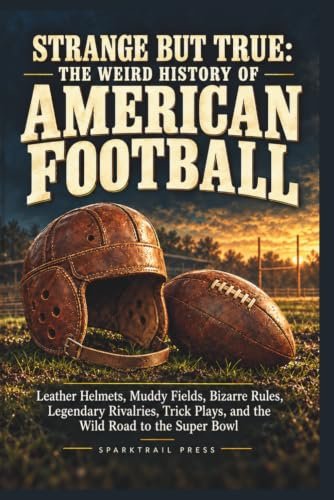
Strange But True: The Weird History of American Football follows that crooked path. It is a book for the fan who knows the score and still wants to know why the score works that way, or for the curious newcomer who suspects this sport has been making up rules as it goes. In a sense, both readers are right.
The first football game would confuse a modern fan
Rutgers and Princeton met in 1869 in a contest often called the first college football game. A modern quarterback would have been of limited use. The play was closer to soccer than to the NFL game people recognize today, and the rules had not settled into one universal American version. Schools played different codes, argued over what counted, and gradually assembled a distinct sport from borrowed pieces.
That messy beginning is part of the fun. Imagine trying to follow a game when the basic definition of football depends on whose campus you are visiting. Old photographs of the formations and clothing show how far the sport traveled.
The scoreboard was a moving target
Today, a touchdown is worth six points. It was not always so. In the early rules it was worth four, then five, and finally six in 1912. Field-goal values changed too. That means comparing scores across eras without checking the rules is a little like comparing currencies after someone quietly moved the decimal point.
The changing values also tell a story about what the sport wanted to reward. Scoring was not just bookkeeping; it could steer strategy. When you read about an ancient low-scoring battle, do not assume the offenses were hopeless or the defenses magical. The goalposts, scoring incentives, and permitted tactics may have belonged to another football universe.
Then came the flying wedge
The flying wedge was a mass formation with a name that sounds like a rejected circus act. It and other dangerous collision tactics became symbols of football’s turn-of-the-century safety crisis. The game drew serious criticism, and the pressure for reform helped lead to a national rules organization that became the NCAA. This is the point where football’s weirdness stops being merely charming. Players were being hurt, and rule changes mattered.
The forward pass was permitted in 1906, part of a wider effort to open up play. It did not instantly produce the airborne offenses we know now. Coaches had to decide whether this strange new option was worth the risk, and the rules around passing kept evolving. Still, it changed what a field could be. Space became an opportunity instead of something to eliminate by piling more bodies into the same unfortunate patch of grass.
Leather helmets and professional growing pains
Early equipment looks quaint until you remember what the players were doing in it. Leather helmets and minimal padding belong in the history of both ingenuity and inadequate protection. The evolution of helmets makes an excellent visual tour of the sport: from soft-looking leather to the hard shells and facemasks that became familiar later. None of it makes the old collisions seem gentle.
Professional football had an equally improvised start. In 1892, William “Pudge” Heffelfinger received $500 to play a game, a landmark in the story of paid players. The industry that would eventually fill enormous stadiums began with deals far less glamorous than a modern contract announcement. In 1920, team representatives formed the American Professional Football Association in Canton, Ohio, with Jim Thorpe as its first president. The league adopted the NFL name two years later.
If you enjoy sports history as much as the action, Canton offers a logical side trip. The Pro Football Hall of Fame is there, and its displays put faces and physical objects to names that can otherwise feel like trivia. Check current opening hours and exhibits before traveling. Even without a trip, following the chronology from a paid one-game appearance to a permanent league makes today’s polished football business look wonderfully improbable.
Trick plays were not a glitch
A sport with evolving rules practically invites creative loophole hunters. Coaches have long used deceptive alignments, reverses, and unexpected passes to make defenders believe the ball is somewhere it is not. The cleverest trick play is often a tiny story with a setup, misdirection, and a punch line delivered by the scoreboard. Sometimes it works. Sometimes the defense reads the joke first.
The Super Bowl did not arrive as a polished monument
The first AFL-NFL championship game took place on January 15, 1967. Green Bay beat Kansas City 35 to 10 in the Los Angeles Memorial Coliseum. It was not even a sellout. The event we now call Super Bowl I only acquired that tidy, official branding later. Imagine pitching that beginning to someone watching the enormous production it eventually became: “Trust us, this will be a thing.”
Later that same year, the NFL’s Ice Bowl in Green Bay gave the sport another kind of legend, with a championship played in brutal cold and decided by a late quarterback sneak. Those two 1967 games show football’s range: a new national showcase in California and a frozen, stubborn contest in Wisconsin. The modern league was coming into view, but it still carried the sport’s older appetite for weather, improvisation, and drama.
Read the game behind the game
The Weird History of American Football is a playful route through leather helmets, muddy fields, strange rules, rivalries, trick plays, and the long road to the Super Bowl. It does not require memorizing every down and distance. Start with one question: what part of football seems so normal today that it must have a bizarre origin story? There is a good chance it does.
Find this title in the SparkTrail Strange But True series, or browse more curious reads on the Books page. The sport may have cleaned up its presentation, but its history still has plenty of mud on its shoes.